Sunday, 16 May 2010

Superstitions and omens. Do we believe in it?

What are superstitions?
Superstitions are beliefs or practices for which there appears to be no rational substance. It is a term designated to these beliefs that result from ignorance and fear of the unknown. Those who use the term imply that they have certain knowledge or superior evidence for their scientific, philosophical, or religious convictions.
An ambiguous word, it probably cannot be used ecxept subjectively. Ignorance of natural causes leads to the belief that certain striking phenomena express the will or the anger of some invisible overruling power, and the objects in which such phenomena appear are forthwith deified, as example, in Nature-worship. Conversely, many superstitious practices are due to an exaggerated notion or a false interpretation of natural events, so that effects are sought which are beyond the efficiency of physical causes. Curiosity also with regard to things that are hidden or are still in the future plays a considerable part, example, in the various kinds of divination. With this qualification in mind, superstitions may be classified roughly as religious, cultural and personal.
All religious beliefs and practices may seem superstitious to the person without religion.
Superstitions that belong to the cultural tradition are enormous in their variety. Nearly all persons, in nearly times, have held, seriously, irrational beliefs concerning methods of warding off ill or bringing good, foretelling the future, and healing and preventing sickness and accidents. A few specific folk traditions, such as beliefs in the evil eye or in the efficacy of amulets, have been found in most periods of history and in most parts of the world. Others may be limited to one country, region or village, to one family, or to one social or vocational group.
Finally, people develop personal superstitions: a student writes a good form of literary piece with a certain pen, and from that moment the pen is lucky; a horseplayer may be convinced that black horses run well for him.
Superstitions has been deeply influential in history. Even in so-called modern times, in a day when objective evidence is highly valued, there are few people who would not, if pressed, admit to cherishing secretly one or two irrational beliefs or superstitions. Such superstitious ideas persist not withstanding the evidence which oppose their validity.


Some polish superstitions:


  1. If you see a black cat you will have bad luck.
  2. If you pass under ladder you will have bad luck.
  3. If you see chimney-sweeper you will have to catch your button and your dream will be satisfy.
  4. If you drop your exercise-book you will have to trample it.
  5. If today is thirteenth Friday you will have bad luck.
  6. If you forget something from house and you must go back from this you will have to seat on chair.
  7. If you break a mirror you will have seven years bad luck.
  8. If you go married you will have to have something blue, old and borrow.
  9. If you say something horrifying or will have to rap in no painting wood.
  10. If you want that somebody have a luck you will have to hold thumbs behind him.
  11. If you see nun when you go to school and you turn three time’s over right arm you will have good luck in school.

British superstitions:

1. Lucky to meet a black cat.
2. Lucky to touch wood. We touch; knock on wood, to make something come true.
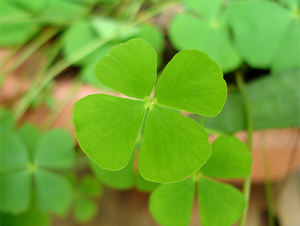
3. Lucky to find a clover plant with four leaves.
4. White heather is lucky.
5. A horseshoe over the door brings good luck. But the horseshoe needs to be the right way up. The luck runs out of the horseshoe if it is upside down.
6. Horseshoes are generally a sign of good luck and feature on many good luck cards.
7. On the first day of the month it is lucky to say "white rabbits, white rabbits white rabbits," before uttering your first word of the day.
8. Catch falling leaves in Autumn and you will have good luck. Every leaf means a lucky month next year.
9. Cut your hair when the moon is waxing and you will have good luck.
10. Putting money in the pocket of new clothes brings good luck.

11. Unlucky to walk underneath a ladder.
12. Seven years bad luck to break a mirror. The superstition is supposed to have originated in ancient times, when mirrors were considered to be tools of the gods.
13. Unlucky to see one magpie, lucky to see two, etc..
14. Unlucky to spill salt. If you do, you must throw it over your shoulder to counteract the bad luck.
15. Unlucky to open an umbrella in doors.
16. The number thirteen is unlucky. Friday the thirteenth is a very unlucky day.
17. Unlucky to put new shoes on the table.


Omens


An omen is a sign that relates to a future event. It may or may not give a time frame as to when this event will occur.
Some omens are signs of good fortune while others are a sign of impending misfortune.
Death omens
Death Omens are found in many different cultures and in almost every part of the world. They can be as simple as watching a picture fall off the wall or as hard to understand as the cry of the banshee. The list of omens is quite long. Why is this? Why do people search for these clues? What is the obsession that humans have with death?The quick and simple answer to the questions above is that death is something most of us do not fully understand. We do not and cannot know with 100% certainty what if anything is on the other side. We wait until our time comes and it is our turn to find out what lies behind the dreaded word death.Some people turn to their faith and take comfort in what they are taught. Others try to learn as much as they can about the physical processes of death and dying. The problem with the latter is that you can learn about the physical aspects of death and dying, you can be shown and taught what to look for when the time is near, but once a person has died there is nothing to learn any further. In the end the results are always the same. No one knows what's on the other side until we get there. As humans the unknown and the inability to control things puts us on guard and makes us uneasy. So we continue our quest for understanding the unknown.

Simple Warnings that a death is about to happen:
  1. A picture that falls of the wall for no apparent reason
  2. A clock that stops
  3. A clock that fails to chime or ring
  4. A mirror that breaks while still on the wall
  5. A cat that leave the home and will not re-enter it
  6. A bird pecking at a window
  7. An owl seen during the daytime
  8. A dog that howls for no reason during the night

More complex warnings:

  1. Hearing a mournful cry or howl
  2. For Irish families this could be the warning cry of the banshee
  3. Hearing horse hoofs or a carriage outside your home
  4. Could be the sound of the Coach-a-Bower
  5. Seeing a black dog with or without glowing eyes
  6. Could be the black shuck or "death dog"
  7. Death Visions


http://www.istockphoto.com/file_thumbview_approve/5585723/2/istockphoto_5585723-common-superstitions-bad-luck.jpg
http://tashapickworth.files.wordpress.com/2009/11/ladder.jpg
http://www.sciaga.pl/tekst/14620-15-superstitions_in_poland
http://www.woodlands-junior.kent.sch.uk/customs/questions/superstitions.htm
http://library.thinkquest.org/27661/docs/super.htm
http://www.cartoonstock.com/newscartoons/cartoonists/jlv/lowres/jlvn661l.jpg
http://www.cartoonstock.com/newscartoons/cartoonists/dpa/lowres/dpan2673l.jpg
http://womenblackjack.com/img/superstitions-inner.jpg
http://open.salon.com/files/superstitions1236956074.bmp
http://www.pararesearchers.org/Ghosts/ghostlore/death/death.html

http://republika.pl/blog_sk_314900/1128446/sz/kruk2.jpg


Tuesday, 11 May 2010

ECO-GADGETS

Nowadays ecology is more important then few years ago. Unfortunately Poles are not as ecological as for example Swedes or Norwegians. The number of eco-gadgets that exist is huge but there are some I really love:

1. Solar tent

Solar tent contains a huge solar battery on it. The energy which is accumulated during a sunny day is very useful. You can charge your cellphone or other things in a special pocket inside the tent. During the night you can switch on the light or if it is cold outside you can use a special warming floor. And all this energy is produced by nature not by men!


2. H2O Multi-function Clock

Multifunction Clock offers the user an environmental design solution for a product that is used in every day life. The H2O battery has a minimum continuous life of at least 2 years. As all the components of the H2O battery are recyclable. Not only is the H2O Multifunction Clock environmentally friendly, innovative and good-looking, it boasts a range of functions that are initiated by simply rotating the clock through 90-degree turns. There is a Timer, an Alarm Clock, a temperature display and, of course, a clock.

3. Led Squeeze Flashlight

Teach children they can generate light for their torches! Squeeze Flashlight is an eco-friendly product which is shaped like a penguin. It is incredibly user friendly as it is designed for children and can also be used as a nightlight. It has been fitted with a powerful new generation LED lamp. Your child will always have plenty of light whenever and wherever they need it. You can also put it anywhere using the handy feet.

4. 'Spudocat'

Spudocat is a raining coat made of potatoes which looks like a normal raining coat (maybe it smells a little bit different but it doesn't mean that it stinks!). Because it is made of potatoes it is of course biodegradable. And there is something else! When the potato coat can't be used anymore, don't throw it away! Plant it in your garden or a pot and after some time you will get a beautiful plant. Yes, a plant! In every coat there is a seed of some plant. It's really amazing, isn't it?

5. Surge for iPod or iPhone - Novothink

With novothink’s hybrid solar charger case, you can now power up your iPod or iPhone literally anywhere under the sun. This solar panel technology enables you to be part of the solar energy solution. Solar energy is a well tested power source that is already being used around the world for numerous commercial, industrial, government and domestic applications. It is powering water pumps in African villages, weather stations in the Antarctic and satellites in space! You can charge your iPod or iPhone touch by allowing the sun to do the work or you can use the included USB cord to hook the Surge up to your computer. You never need to remove your iPod or iPhone touch from the case to charge it!


6. Solar and Crank Radio

The Solar and Crank Radio keeps things simple. This AM/FM radio can be charged in a number of different ways. It can be charged using mains electricity or it can be plugged into a USB hub. However it can also be charged in an eco-friendly fashion using solar power or the crank technology! This light weight radio is practical and can be used in the garden, on a boat or when camping. And it even allows you to save energy! One minute of cranking this radio delivers 20 minutes of play - five hours of sunlight delivers 30 minutes of play - it takes between 20 and 30 hours of sunlight to fully recharge the battery - the radio can be fully charged using the USB too.

And what? Wouldn't you like to have this kind of a product yourself now? It is great how useful these products can be. Poles, be more eco! It is very simple. ;]


WOMEN IN DIFFERENT CULTURES

No one can deny that woman motif accompanies humanity for ages. It always was and probably alway will be present in art, literature and social discussions. But not only that. Women are actually real human beings, but some of cultures seem to forget about that.

WOMEN IN JUDAISM

No one can deny that woman motif accompanies humanity for ages. It always was and probably alway will be present in art, literature and social discussions. But not only that. Women are actually real human beings, but some of cultures seem to forget about that.

In Judaism, every person, in accordance with the Torah, is determined by another role in life.Man should accept the reality that God created according to his will. This principle, like many others in religion, there is no transformation of socio - cultural. Nevertheless, the role of women in the last centuries has taken on a new dimension in the world of Judaism. And at least in part of this world.
The birth of a girl accompanied by a ceremony in Judaism Simchat Bat, a symbolic greeting and a covenant with God. Your little girl is given in the prayer on the first Shabbat after the birth.Jewish girl becomes a woman aged 12 - 13 years. Solemn celebration of the Bat mitzvah, which begins a period of personal responsibility (now) women of their actions for compliance with the law and religious principles. The girls from an early age they learn all the principles of household management in accordance with the provisions of the Talmud and the ritual purity of food items.They learn about the traditions, rituals, rules and prohibitions on their daily lives. Since women are not required to explore theological knowledge, and once even had an obligation to go to a religious Jewish school, and to participate in services, as opposed to boys. This does not mean that it did not. History knows many women scribes.

Women have received from God the other tasks than men. They have to fill in the Jewish community a different role. Their roles in the life of Torah states according to the nature of women's nature. The main task is to build women and maintaining a positive atmosphere at home, guarding its proper and healthy functioning and proper education of children. It shapes the character of a woman and a picture of the family, and ensure observance of tradition. Should strive to zaszczepiać faith and religion, not only among relatives, even when a man weakened in faith and subjected to its weaknesses. For a woman to fully perform their duties in a man should help her by providing the right conditions.
During the wedding ceremony the bride is presented ketuba, or marriage contract. In this document are saved her husband's duties towards his wife. He undertakes to provide his wife with food, clothing, finances and meet its other needs, including sexual abuse. This document is intended as a safeguard for women's rights and ensure its sense of security.
If a woman wants to re-enter into marriage is such a possibility. May do so only after 90 days from the time when her husband throws her hands in a get, or divorce document, written personally by him or his agent in the presence of a witness.
A woman has many religious duties. For example, lights Sabbath candles and refuses blessing before the meal. Must pray at least once a day, or the canonical texts of spontaneous prayer.
Historically, the status of women in Judaism was very low. It was not worthy of a covenant with God, because it was considered as a source of impurity. Any midwives was "unclean" for 7 days after the birth of a son, and 14 days after the birth of her daughter. Could come to the temple only after 40 days after birth a son, and after 1980 - after the birth of her daughter. After these days of purification mother had to offer in the temple of a young pigeon or turtledove (sin offering) and one lamb (burnt offering). She could not read the Torah publicly in the synagogue and did not have to take a pilgrimage to Jerusalem. She could not stay longer with a strange man, nor talk to him. She had equal rights to children and slaves. After entering into marriage became the property of her husband, and after his death, had no right to inheritance. Men were free to move away from their wives in certain situations. Showing the so-called bill of divorce, the man could leave, or even expelled from his home wife (unfaithful), not worrying about its future.
Most of the principles of Judaism has survived in nearly or completely changed shape until modern times. A clear change in this regard took place only in the eighteenth century with the modern women's emancipation and the birth of the so-called. Jewish Enlightenment movement.Further moves towards equality in society for men and women occurred in many varieties of modern Judaism, of course, outside of orthodox Judaism, which still adheres to all the old Talmudic law, including provisions relating to women. The Orthodox church, men and women sit separately. Contacts between men and women governed Halacha. It prohibits two people stayed on the opposite sex in a closed room. This is allowed only in case of husband and wife, parent and child and adult with a girl for 3 years, or are a boy of nine years of age. The most radical and orthodox followers of Judaism are Hasidim. Chasydkom not even allowed to read newspapers, or use other media. They live in a reality created by men. They have a very limited career opportunities. They can work, inter alia, as a kindergarten teacher, teachers, dressmakers, and shop vendors. The training is almost the exclusive privilege of men. I wrote the law, because they are determined by the Jewess Chassids Lilit term, which means liberal and ambitious woman who can not devote himself to the family.
At the turn of the century in many Jewish circles moral reform was introduced. Leniency has, for example, the principles of proper appearance. Women began to wear fashionable clothes, and some have abandoned the wearing of wigs and other head coverings. Previously, women could not show their hair to anyone except her husband. Have access to education and develop their interests. In Reform synagogues and women have equal status with the opposite sex. They do not have to sit away from the men in the church services, holders of honorary presidents honorable functions synagogues, and even allowed them to feature rabbi.

WOMEN IN CHRISTIANITY

The presence of women in Christianity has always been visible. In the Bible you can find many parables and history, with the participation of women. Were frequently present at Christ. In the gospel according to Luke. Matthew says Joseph took the body, wrapped it in a clean linen cloth, and in his own new tomb which he had hewn in the rock. Before entering the tomb rolled a great stone and walked away. Mary Magdalene and the other Mary were there, sitting opposite the tomb. (Mt 27, 59 -61) also applies to women as the first early morning went to the tomb of Jesus.
Model the role of women in this religion is of course the mother of Jesus - Mary. Her humility, trust in God, hard work and cleanliness should be the benchmark for every Christian. Pope John Paul II in his Letter to Women wrote: fullest expression of "feminine genius," the Church sees in Mary and find in it a source of constant inspiration. Mary called herself the handmaid of the Lord. Through obedience to the Word of God adopted a privileged vocation - not easy - wife and mother of the family of Nazareth. By serving God also gave people at the service: the service of love.
Maria is not the only important figure in Christianity. Over 2,000 years of its history the church beatified and canonized a lot of women from different ages and nationalities. These include not only religious, martyrs reflecting life in defense of religion, but also the mother sacrificing love for their children.


The Catechism of the Catholic Church is recorded that a man and a woman have the same dignity, were created in God's image, were "the image of God." In his "being a man" and "being a woman", they reflect the wisdom and goodness of the Creator. (...) "Perfection" of man and woman reflect something of the infinite perfection of God: the mother of excellence and perfection father and husband. Both the woman and a man worthy of respect. Although there are differences between physical and psychological beings are complementary. With these characteristics show The role of women in social life and family. The primary mission of women, resulting from its nature, is motherhood. The family should be the main place of activity, since it carries with it particular, compelling value. Activities pozarodzinne women remain in the shadow of the essential role of wife and mother. A woman should have the right of free choice, the state of life, equal access to education and training. They can work in all areas of life, preferably in accordance with their talents. They can perform all the functions and hold a variety, including primates, position.
Women can study theology, but in the Catholic Church are not admitted to the priesthood. Of course, I mean the ministerial priesthood, as required to fulfill the responsibility of the royal priesthood of all members of the Church. John Paul II issued a ruling on this issue in his apostolic letter Ordinatio sacerdotalis, in which he stated that the church does not have such a power to give ordination to women.
Adam Szostkiewicz written in his article said that women in early Christian communities could play a range of important functions. Particular concern surrounded the widow. In the twelfth and thirteenth century, a rapidly growing female monasteries give learning opportunities to many women.
Father Maciej Zieba says that women in the Middle Ages had an impact on both the ecclesial life and politics. They could devote themselves to various works. They were both in koronczarstwie, baking, księgarstwie and blacksmithing, złotnictwie, locksmithery or brewing.Do not have to take her husband's surname after marriage, and continue its disposal of their assets. According to her father M. Zięby role and importance of women in society decreased with the development of secular law.
But we can not fail to mention the heinous deeds of the church over women, when the dust burned at the stake as witches.
A. Szostkiewicz in the aforementioned article claims that in the history of the Church are two intertwined strands of view, the position of women in society. One source was a kind of hostility towards women, the second derives from the belief in fair treatment of all people regardless of gender.
The desire for self-control representatives of the opposite sex, primary disorder of harmony and unity between women and men, results from the human tendency to sin, which in turn is a consequence of original sin.

WOMEN IN ISLAM

The role of women in Islam, Allah described. He gave her a different nature than man, which specifies its place in society. It may take on different roles, but among the most important are mentioned: the role of mother, wife, daughter, sister, grandmother, niece, niece, and premiums.Each of these social roles in Islam is associated with very defined principles.
Women are encouraged in Islam to marry after they become physically mature. Between spouses is to be concluded nikah, or marriage contract that contains 6 to the conditions that the marriage was recognized and enforceable. In one of them mentions that a woman entering into marriage may not be in time iddah, that is, the waiting period. It must of course be unmarried.
Although a Muslim can marry a Jew or a Christian (if chaste and unmarried) is a Muslim can marry only a believer of Islam. Islam prohibits the abuse of women and allow them to demand a divorce.
Joining in the marriage team generates specific roles and responsibilities of women. It becomes primarily responsible for the family and its moral foundation and the atmosphere at home. She has taken various decisions in the home environment and is responsible for their consequences.It has also ensure proper education of the younger generation. In shaping the children's religious education is essential. Islam assigns women in this field an important position, since it is the first woman to host a man of Islam, a woman was the first martyr dying for the sake of this faith.A woman has to uphold the morality of his family. Maybe even give a man advice, oppose any shortcomings of the principles of religion, corruption, forgery, lies. The main goal of these treatments is to build strong and healthy society.

For ladies can effectively carry out their vocation should first receive a good education. They learn primarily medicine, nursing, tailoring, embroidery. Can attend mosques for prayers, lectures and various activities. In addition to the study may also take such a job as a social worker or teacher, if it does not affect adversely affect their household duties. Often it is necessary for economic reasons the family. Although the maintenance of women and the house is primarily a man. He has to protect her and care about her welfare.
Since women, like the man expected to be interest in social life and participation in the political life of the country. Some even mention the religious obligation, for belonging to the Islamist party to power in the resurgence of religious principles.
Even if a woman wants to engage in work or politics, is not eligible for the senior positions, including where to direct itself seemed would take decisions or judgments. It can serve as a juror and the court or be a member of the advisory body to the Caliph. For known exceptions include Pakistanka Benazir Bhutto and Iranian Szirin Ebadi.
Benazir Bhutto, she studied political science and history at Harvard and Oxford. In 1982 he was president of the Pakistan Peoples Party, in 1988 and 1993 to 1996 she served as Prime Minister of the Islamic Republic of Pakistan.
However, Szirin Ebadi was among the first women in Iran as a judge. The whole world may know her as she received the Nobel Peace Prize for championing human rights, especially women and children, and contribute to the democratization of Iran.
Muslim women have a lot of bans on the private sphere and the public to be observed.
They must not reside with niespokrewnionym man in solitary confinement. This is only possible in very specific situations and only in the company of mahr, or a relative, he can not marry. For these exceptional circumstances include: saving lives, healing, learning Islam, wedding ceremony, meal, law enforcement and emergency aid, such as accident or disaster.
In public life, a woman can come into contact with men niespokrewnionymi, also only in the company of mahr in the street, in the mosque, service shops, institutions, hospital, classroom, etc.
In all these situations and places contacts between men and women must be kept to a minimum. Women should be as far away, separated from the representatives of the opposite sex. Valid them modest behavior, lowering the eyes during a conversation.
Has certain restrictions on travel. She must not depart alone more than 24 hours away. It is related to its security.
It is also a number of indications concerning the dress code. There are two areas that must be obscured in the presence of other people. Ghalida Aura, is the area between the chest and knee, and Aura Chafifa - the whole body except face and hands. They can also use perfume.
Muslims claim that in Islam there is no problem of equality of men and women, it is rather a problem of Western cultures. Do not agree with the charges, allegedly mistreated women.Sacred Law prohibits Szari'atu violence against women, but this does not mean that the law is not abused or over-interpreted. That has happened in the case of governments mudżachedinów and the Taliban regime in Afghanistan. In 1993, Iran accused the United Nations (...) women receive citizenship. In 1993, Iran strengthened, inter alia, provisions for clothing. Women must wear czarczaf under penalty of flogging. On the 41st International film festival in the Spanish city of San Sebastian, the first prize, the Golden Shell, received an Iranian film "Sarah", talking about the brutal discrimination against women in Islamic religious state. The film "Sarah" could not be shown in Iran.
Today, the role of women worldwide is increasing. Are present in different institutions and organizations. Willing and able to take care of their place in society. But the reality is not free of examples of violations of human rights, including women. I believe that no great religion urges to harm people. This is done because of the human individual choices.
I believe that despite the different rules and habits proper to each culture or religion, a woman has, like the man, his role. Assessment, which is larger and more significant will always be subjective. Each is different and needed. Only their sum forms a complementary picture of the world and mankind, so let every man fulfills its mission as best they can, in accordance with their conscience, religion, worldview, respecting themselves and others.


Bioethical problems


Bioethical problems- How far can we go?

Progress in the life sciences is giving human beings new power to improve our health and control the development processes of all living species. Concerns about the social, cultural, legal and ethical implications of such progress have led to one of the most significant debates of the past century. A new word has been coined to encompass these concerns: bioethics. It touches most complex problems of the humanity.

Bioethics is a philosophical study about science that involves human and other living creatures directly: medicine and biology. Bioethics is frequently noticeable among disciplines such as: life sciences, biotechnology, medicine, politics, law, philosophy, and theology, in many hard cases in which human life and dignity are in danger.

Bioethical issues has been discussed widely among centuries, lots of views has evolved with grater knowledge. Moment in history from when public attention focused on this case were biomedical experiments following the revelation of Nazi experiments conducted during World War II, later problem of life-ending medicine ethics, modern bioethics though concerns more about today’s biotechnology and it’s possibilities: stem cell research, genetic testing, cloning, gene therapy.

Human rights

Universal Declaration of Human Rights, proclaimed that everyone is entitled to all the rights and freedoms set forth therein, without distinction of any kind, such as race, colour, sex, language, religion, political or other opinion, national or social origin, property, birth or other status,

Modern society and all humanity nowadays meet problems of unwanted life extinction and it’s termination. How to cope with life that have no chance to express itself and why should we do it after all? Are we in power to decide which life is valuable and which unwanted? Where to sart and when to stop artificial life elongation? Those questions should be answered by each and everyone with solemnity and morality.

Abortion- act of terminating unborn life. All of the arguments pro and against abortion boil down to six specific questions. The first five deal with the nature of the zygote-embryo-fetus growing inside a mother's womb. The last one looks at the morality of the practice. These questions are:

  1. Is it alive?
  2. Is it human?
  3. Is it a person?
  4. Is it physically independent?
  5. Does it have human rights?
  6. Is abortion murder?

Both sides use the same question s to support their logic and morality they just answer them.

An abortion can occur spontaneously due to complications during pregnancy or can be induced, in humans and other species.

An abortion is medically referred to as therapeutic when it is performed to:

  • save the life of the pregnant woman;
  • preserve the woman's physical or mental health
  • terminate pregnancy that would result in a child born with a congenital disorder that would be fatal or associated with significant morbidity[1 or
  • Selective reduce the number of fetuses to lower health risks associated with multiple pregnancy

An abortion is referred to as elective when it is performed at the request of the woman "for reasons other than maternal health or fetal disease." Population control and one-child policy in China is often connected with this subject.


Euthanasia- practice of ending a life with mercy to dying person which terminate the pain and suffering. Is also seen as a voluntary suicide or as a murder when it has to be assisted. Proponents typically consider a death that increased suffering to be "wrongful" while opponents typically consider any deliberate death as "wrongful." Other case is life extinction and life support.

“Medicalized killing of a person without the person's consent, whether nonvoluntary (where the person in unable to consent) or involuntary (against the person's will) is not euthanasia: it is murder. Hence, euthanasia can be voluntary only.”

Several governments around the world have legalized voluntary euthanasia: The United Kingdom and United States among others.


All of activities that can increase fertility or lead to impregnation are also controversial:

  • In-vitro fertilization
  • Artificial uterus (or womb)- a device that allows to replace the process of pregnancy outside of a woman body, current technology does not allows to perform all the development of featus in artificial conditions.
  • Artificial insemination
  • Three-parent babies- human offspring that contain DNA from 3 parents. Is now researched in China but no fetus was born yet.
  • Sperm and eggs (donation)


Future problem-Transhumanism


Transhumanism is symbolized by H+ or h+ and is often used as a synonym for "human enhancement" is an ideological movement or pseudoreligion that supports any kind of way which can improve human health or general condition. Science and technology is method to gain full humanity- transhumanity. Gains are to within those methods reduce poverty, disease, disability, and malnutrition around the globe but also to enhance human bodies at individual level, control the evolution of human and other creatures. Transhumanists are for instance not interested in preservation natural biodiversity and natural systems on any other purpose but to use it. Transhumanist goals can be gained by using: genetic modifications on human embryos in order to create “designer babies”.


Transhumanism has been described by one critics, as the world's most dangerous idea, while proponents claims that it is the "movement that epitomizes the most daring, courageous, imaginative, and idealistic aspirations of humanity"


Future of genetic engineering


Are you concerned about bioethical issues?

Are you human or transhuman:)?

Despite ventures and problems biotechnology has bright sides. Do you see any? (watch the film from the link above)